Introduction: What I Mean by “Journal Sketching”
I use the word journal sketching to describe what happens when I carry a small sketchbook on a walk, stop at a wildflower, draw it, and write a few lines beside the drawing. It is a blend of an art journal, a sketchbook journal, and a written diary, all in one book. On a spring walk in April 2024, I paused by a patch of trout lily, sketched its drooping yellow flower in pencil, added a thin wash of watercolor, and wrote two lines about the damp soil and the early morning dew. That page is not accurate. It is vivid, because I saw closely.
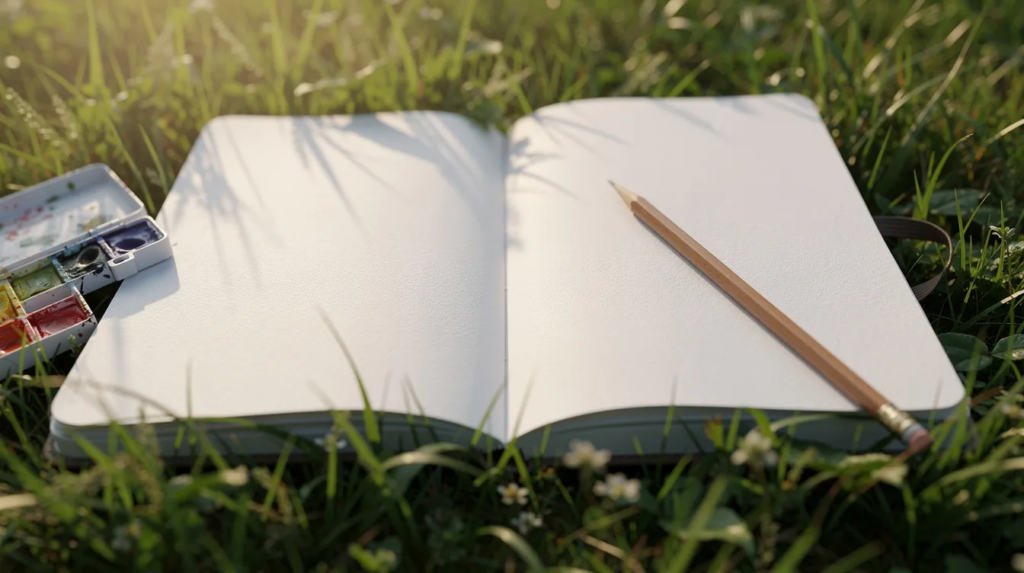
The whole method fits a coat pocket: a small sketchbook, a pencil, a few pans of watercolor, and a water brush. I pick one flower, draw it where it grows, then write the date, the place, maybe the smell or the insects visiting. I spend more time looking than drawing. My favorite pages are rarely the most accurate ones. They are the ones where I stopped long enough to notice something I would have walked past.
This is for adults who feel like beginners and want a quiet, low pressure habit. I am not a teacher. I share what I do and what I have noticed. The rest of the article covers choosing a sketchbook, simple supplies, mixed media, page ideas, and how I keep it going week after week.
What Is a Sketchbook Journal or Illustrated Journal?
A sketchbook journal is a book where sketches, writing, and small collected bits live together. You can incorporate found papers like ticket stubs, pressed leaves, or a petal that fell on the path. It is not a studio sketchbook meant for finished art. The terms overlap: an art journal, a sketchbook journal, and illustrated journals are all names for roughly the same thing. I just say “my journal.” An illustrated journal combines drawings and written notes, and that is enough of a definition. Sketchbooks are suitable for both drawing and writing, so the line between categories blurs fast.
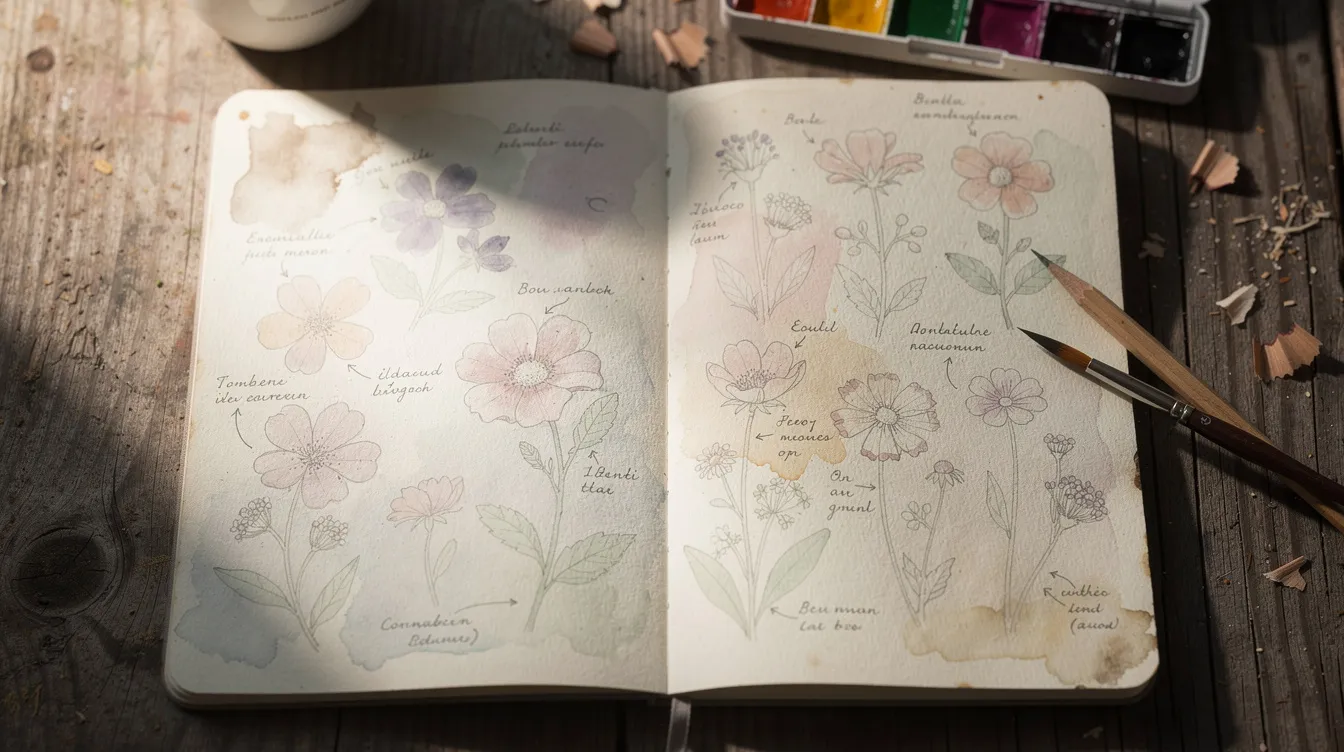
A concrete example: a summer 2023 spread with three pencil sketches of oxeye daisies in different poses, a patch of pale watercolor behind one, and a note that reads “July heat: field scorched, daisies drooped, bees scarce.” Loose line drawings, short captions, the date in the corner, one area detailed and another left as plain pencil. Travel journals are a type of art journal focused on experiences, and mine is similar, except the journey is a twenty minute walk along a gravel road. Pressed petals and leaves sometimes end up pasted in the margins. If you want to know what to do with a flower once it is picked and dried, I have written about flower press art on the blog.
A sketch journal is a low pressure laboratory for observation and experimentation. Sketchbooks support creative exploration and personal expression. There is no standard of “good.” The point is to record what you notice, not to make art for a wall. A sketch journal encourages low pressure experimentation, and that freedom is the whole appeal.
Why I Keep a Journal Sketchbook (Beyond “Being Creative”)
In May 2022 I started stopping for a single plant instead of rushing past everything. That small change turned walking into something different. Now, flipping through winter pages, I see the first celandines in late March, cow parsley in May, rosebay willowherb in August, each with a tiny sketch and a date. Those pages are a quiet log of the seasons, and they fix time and place in my memory more powerfully than photos do.
Sketching can provide relaxation and emotional expression. I would not call it meditation, but drawing a clover leaf slowly in pencil does force me to pay attention to the present moment, and that calms my thinking on a busy week. Drawing a hedge bindweed plus three lines about where I found it fixes the plant in my mind. Capturing fleeting ideas in sketches creates a reference library that I can flip through months later and still smell the damp earth. The journal tells a story of where I walked and what grew there, and I tend to remember those walks far better than the ones I hurried through. I have written a post on the blog about feeling drawn into nature, for readers curious about why this kind of slow looking appeals to so many people. It is less about technique and more about what the habit gives back.
Choosing a Journal: Paper, Size, and Format
I have used ordinary notebooks, hardcover sketchbooks, and dedicated art journals. You can use any sketchbook for nature journaling, and all of them work for pencil. Paper is what matters. For dry media such as pencil and colored pencil, 90 to 120 gsm is fine. But thin paper makes me timid when I add watercolor, because it buckles and dries in ripples. I now prefer around 200 gsm when I plan to paint. Watercolour sketchbooks are designed to handle wet mediums, and the difference in how the paper feels under a damp brush is immediate: heavier paper stays flat, takes a wash evenly, and forgives a second layer.
A basic sketchbook with drawing paper is ideal for beginners who mostly use pencil. Midori cotton notebooks are excellent for pencil drawing if you want something with a fine, smooth surface. Art journaling can be done on loose paper or in bound journals, so you can also use loose sheets clipped to a board if that suits you. You can use loose paper or bound journals depending on what feels right.
Sizes I have used:
|
Size |
Best for |
Trade off |
|---|---|---|
|
A6 (pocket) |
Short walks, quick notes |
Limited space for details |
|
A5 (most days) |
One plant, side sketches, notes |
Small enough for a coat pocket, quick to fill so you feel progress |
|
A4 (home) |
Detailed winter studies |
Too heavy to carry on walks |
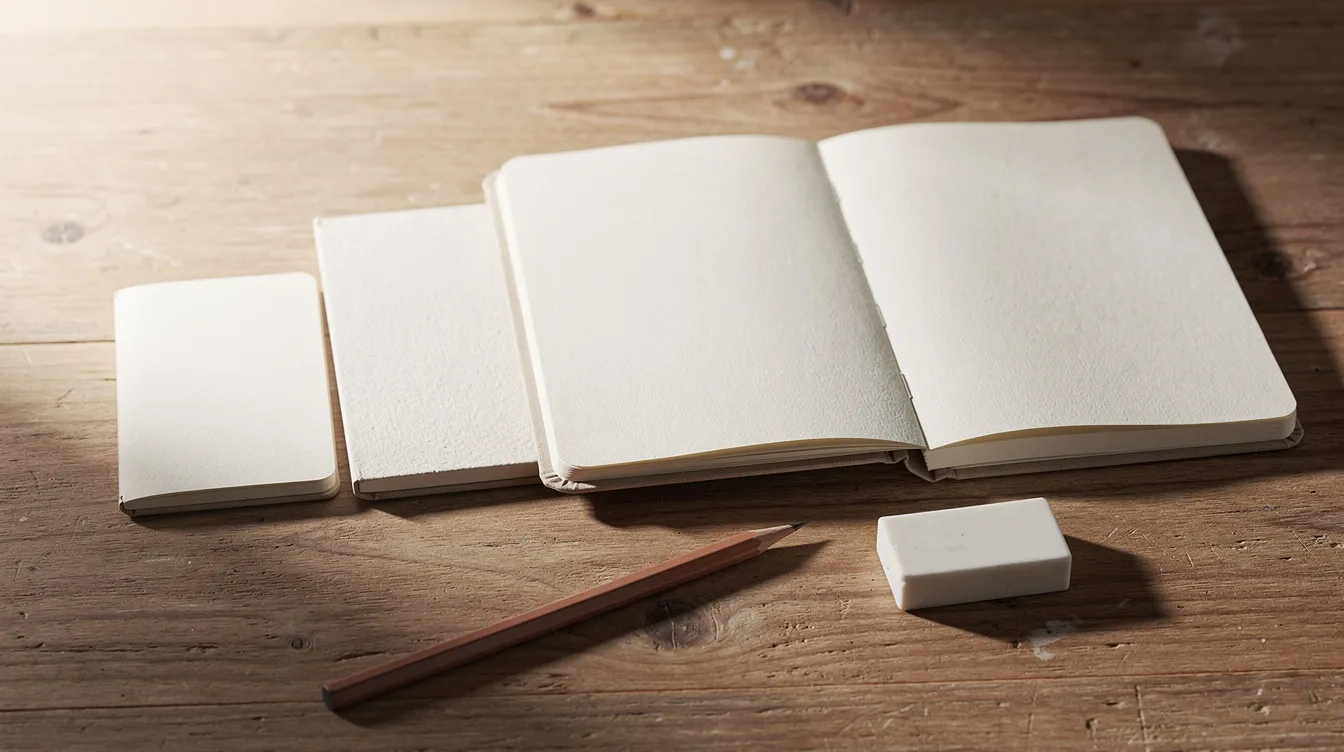
A hardcover with a cloth wrapped cover protects pages outdoors but can be stiff to hold open. A spiral binding lets the book lie flat, which helps when you write across a double spread. Softcover is lighter and cheaper. The price of a good A5 watercolor sketchbook is modest, and it lasts months. Decide based on what you plan to do most: a small, sturdy watercolor sketchbook for color washes, a mid weight notebook if it is mostly writing with quick sketches.
Basic Art Supplies I Actually Use
I keep my art supplies simple enough to fit a small pouch, so I never talk myself out of going. Expensive gear is not needed. Use portable art supplies for drawing on the move, and you will actually go. Art journaling materials include paint, pens, and various papers, but on a walk I carry far less.
-
Drawing tools: an HB pencil for most lines, a 2B for darker shadows, a small sharpener with a shavings container, a white plastic eraser. An optional 0.3 waterproof fineliner adds clarity to labels. A marker or pen is useful for bold lines, though I reach for pencil first. On smooth journal paper the pencil glides; on textured paper it catches pleasantly and leaves a grainier line.
-
Watercolor: a pocket set of about 12 half pans. Greens (cool and warm), a couple of yellows, a violet, a red and a blue cover most wildflowers. A water brush holds water in the handle, so no jar is needed. It changed my walks more than any other single item.
-
Extras: a scrap of cloth or paper towel for dabbing the brush, and a folding pad or plastic bag to sit on, because wet grass ends sessions early.
I have written a guide to starting a nature journal on the blog, which goes through a similar kit with extra notes on page layout for readers who want more detail on materials.
How I Build a Journal Page: From Blank Spread to Finished Sketch
Here is a specific example: a May 2024 page about red campion and cow parsley on a roadside verge. I draw flowers where they stand and do not pick them. A plant in place shows how the stem leans, how the leaves sit, and what grows alongside. This suits Leave No Trace principles, and it keeps me from trampling around delicate plants.
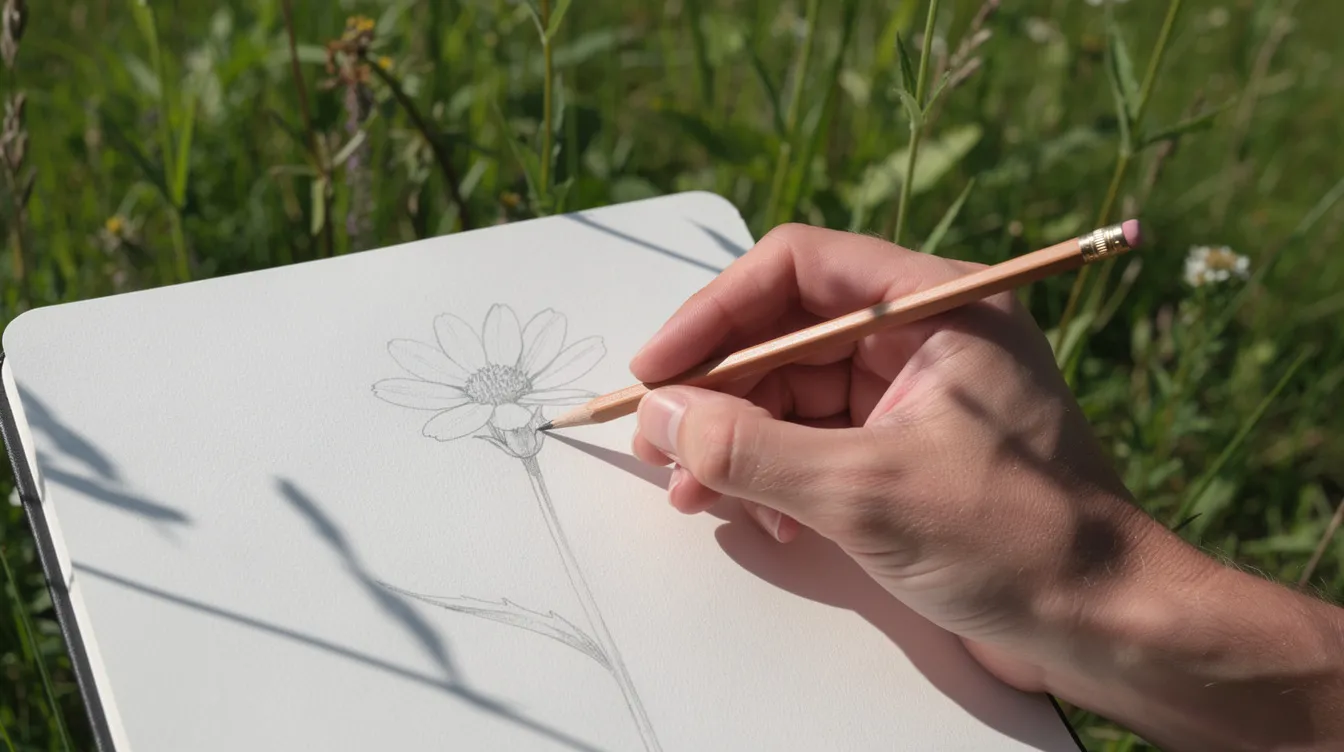
Before pencil touches paper I watch for a full minute. I count petals, check whether leaves alternate or sit in pairs, and figure out how the stem bends. Use pencil for initial sketches of flowers, and keep early lines light. Sketching frequently aids in observing proportions, angles, and light shifts. To get the form right, close one eye and hold a pencil at arm’s length to compare flower head width to stem length. Draw what you see rather than what you think you know: angled petals look short and wide from certain angles. Draw the negative spaces between leaves and stem. Focus on flower shapes for realistic drawings, and the rest follows.
Order of the page:
-
Date and place at the top.
-
Main sketch slightly off center, leaving room for details.
-
Small detail sketches (leaf, bud, seed pod) around it, with labels.
-
Field notes beside the drawing: weather, name or “unknown, check later,” two or three observations (smell, visiting insects, height against the grass), and one question I could not answer on the spot.
Including brief notes with sketches preserves context and observations. Regularly dating sketchbook pages helps track growth. Borrow small boxes or dots from bullet journaling to separate notes, but keep the composition loose with plenty of white space and light color. Bullet journals can also serve as sketching spaces, and the two habits share more than you might expect. Drawing from life sharpens observation skills, and successful sketching balances speed with observation. The whole process takes about twenty minutes.
Simple Journal Sketching Exercises for Nature and Daily Life
When I do not know what to draw, I use tiny exercises to fill a page without anxiety. Start with common, sturdy flowers: daisies, buttercups, dandelions, clover. They tolerate you hovering. Delicate or rare plants make poor first subjects. Consider a theme for your nature journal, like travel or local flora, and return to it across the season. Use prompts to inspire daily entries in your journal, even if the prompt is just “draw whatever is nearest.”
Focused wildflower study: devote one page to a single plant such as a dandelion, with front view, side view, leaf, and a little map of where you found it. Sketching outdoors helps capture natural flower details. The side view often sends your drawing in a different direction, because many flowers look quite different from that angle. Botanical illustration, a tradition artists developed to identify plants accurately, uses the same habit of showing a plant from more than one angle. You can borrow that idea without aiming for that level of finish.
Indoor and quick options: on rainy days, draw an onion, a spoon, or a jar like a botanical specimen with labels. Create a “three things from today” spread. For readers who feel they cannot draw, try five two minute sketches with no erasing. These are fun and they build confidence. Experimentation with sketching styles helps discover natural artistic preferences, and a journal can be a testing ground for artistic techniques.
Mixed Media in a Journal: Combining Pencil, Ink, and Watercolor
My pages are mostly pencil with light watercolor and sometimes ink, which technically makes them mixed media. Art journaling combines drawing, painting, and writing techniques, and mixed media art journaling uses multiple mediums like paint and ink. You could also play with gouache or collage. Art journaling allows for mixed media like paint and collage, and art journaling encourages experimentation with various materials and styles. Treating a sketch journal as a private test pad removes perfectionism, so do not worry about ruining a page.
Typical sequence: light pencil sketch of a clover, waterproof ink over the main outlines if you like, a pale green wash laid down in one pass, then colored pencil to deepen the shadow under the leaves. Let the first layer dry before adding a second. Leave small patches of white paper for highlights. Watercolor can enhance flower sketches with color, and layering techniques improve the depth of flower illustrations. Using ink or pen builds bold, deliberate mark making, though it asks for more confidence than most people have in their first week.
Color ideas for wildflowers: mix two transparent colors for soft pinks on campion, or yellow with a touch of brown for dried grasses in late August. Test combinations on an experimental page at the back of the book. A sketch journal helps discover personal art style over time, and that happens by trying things, not by reading about them. Thin notebook paper buckles with water; the small watercolor sketchbook I started in autumn 2023 dries flat every time. Use a damp brush, not a dripping one.
Fitting Journal Sketching into Real Life
I do not draw every day, and my journal has gaps, rushed pages, and half finished sketches from busy weeks in 2022 and 2023. A wobbly page is still a record of an afternoon. Flipping back through dated entries tracks artistic progress, and I totally enjoy seeing the awkward early pages because they show how much changed. A sketch journal helps develop drawing confidence simply by accumulating pages.
Consistent sketching habits can be developed with a simple routine. Keep the sketchbook and pencil by the front door. Ten minutes on a lunch break or while the kettle boils beats a planned afternoon you keep postponing. Daily sketching can help develop your artistic skills, and daily sketching habits enhance creativity in art journaling. Drawing regularly encourages consistency in practice. Regular sketching strengthens hand eye coordination. Keeping a sketching journal builds consistent visual practice. I aim for one page per walk, and some days it is just a leaf with a note.
Bridge gaps with a new date and one line about what changed in the hedgerow. Attach sketching to existing routines: a weekly market trip, a Sunday walk, a train commute. Photography of sketches can serve as a digital backup if you want to review pages on your phone. Using a simple indexing system aids in organizing sketches for future reference, and creating an index at the beginning assists in finding sketches later. A hybrid organization system combines chronological and thematic approaches, so you can log by date but also mark certain themes or species. Common stumbles I still make: trying to draw a whole meadow instead of one plant, and skipping the walk because of overcast weather. Overcast light is actually kind to flowers, with softer colors and gentler shadows. I only stay in when it rains.
Where to Go Next: More Posts and Personal Experiments
Journal sketching is an ongoing experiment, not a project to finish. On Wildflower Sketch I write more posts about drawing roadside plants, labeling a botanical sketch, and choosing small sketchbooks for walks. There is plenty left to explore in every direction, and the creativity never runs dry because every season brings new subjects.
Pick one idea from this post and try it on your next walk: a single page study of a plant you do not know yet, with a date and a note about the place. Over a season the collection of rough pages starts to feel like a personal field guide, and that is worth more than any class. I hope you discover something you did not expect to see. Next spring I plan to devote one whole bound journal to hedgerow flowers between March and June, using the same simple methods described here. That is the sign of a good habit: wanting to do it again.
FAQ
Do I need to be good at drawing to start journal sketching? No. The skill that matters most is looking carefully, and walking and sketching builds it. Keep the rough first pages, because they show how much you develop. The answer is always to begin.
What is the best sketchbook size for outdoor use? I prefer around A5. It fits a pocket or small bag and gives room for one plant and a few notes. A6 is ultra portable but limits detail. A4 stays at home.
Should I use pencil or ink first? Pencil, because it forgives mistakes. Add watercolor on top, and save ink until you feel more confident.
How long should one sketch take? Fifteen to twenty minutes for a single flower with a little color and a few notes. With less time, skip the painting and do pencil with a short caption.
Is it okay to pick the flower and draw it at home? I prefer to draw in place and leave plants where they are, especially in protected areas or where a species is uncommon. A reference photo is a good compromise if you want to finish the page later.