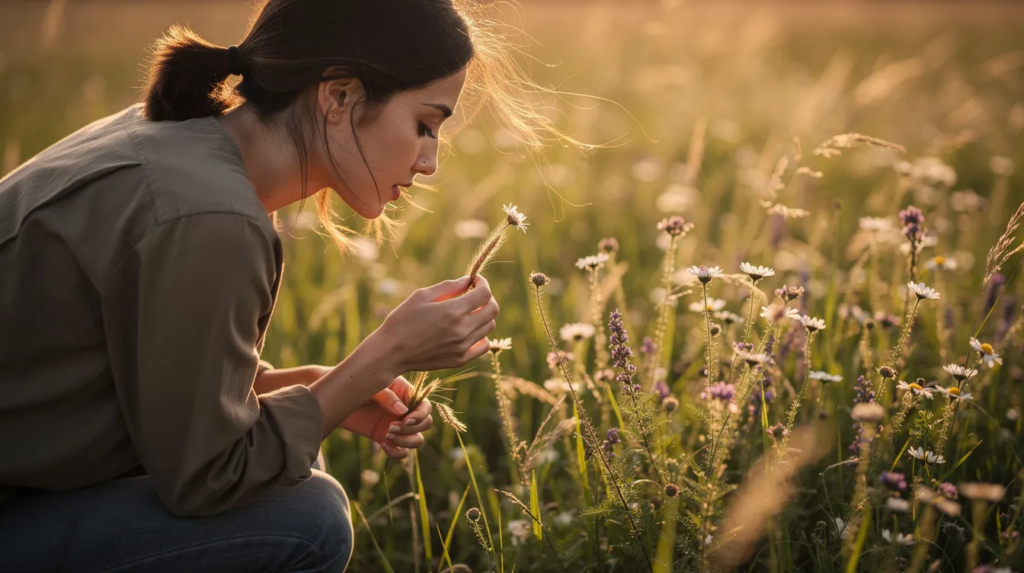
Something yellow at the edge of a field catches my eye, and ten minutes later I am crouched on the verge, wondering why the leaves clasp the stem the way they do. That is what being drawn to nature feels like for me: attention that narrows down to one plant and stays put.
Why I Feel Drawn Into Nature
The small snag is always the same. A color, a shape, a flower I haven’t noticed before. I stop walking, and for a while the rest of everyday life drops away. Feeling drawn into nature, to me, is that quiet pull to stop, look closely, and sometimes sketch what is there; the Wikipedia entry on the biophilia hypothesis gives a name for it as an innate human need to affiliate with other forms of life. I offer it as a starting point for the curious, not as a claim about what it does for anyone.
Attention Restoration Theory posits that natural environments restore cognitive resources, and I find that true in a simple way. After twenty minutes beside a ditch flower, my head feels quieter. Natural settings can trigger feelings of wonder and reverence, and nature immersion can foster emotional resilience and a sense of connection. I notice these things without measuring them, which is part of why keeping a nature journal matters to me: it turns a walk into close attention, a steadier mind, and a personal record of the plants I have actually seen.
Noticing is the first step. Drawing is the second. By the time I am home, all I remember is “a small purple flower, maybe a vetch,” but a sketch keeps the actual shape. I am a hobbyist with no training, and the value is in the looking, not the result. If you enjoy walks, want to draw wildflowers, or feel you can’t draw but still want to start a simple nature journal, this is for you. I share the basics I use: what to carry, how to look closely, how to pencil a flower step by step, add light watercolor, note petals, leaves and veins, write a few words beside the sketch, press flowers, and use drawing to help identify what you found.
Looking Closely at the Natural World
I spend about two minutes before picking up the pencil. I walk around the plant and observe its overall shape, the lean of the stem, which way the flower faces. Practicing mindfulness in nature this way improves emotional well-being, though I do it because I want to draw something that looks right.
A sketch makes me ask questions a photo lets me skip. Are the petals all the same size? Do leaves pair up or alternate? Is the stem round, square, or ridged? Contour drawing, where the pencil follows the edge of the form without lifting, improves observation skills and forces me to really see. Engaging all five senses enhances the experience of nature, so I also notice the scent, the texture of a leaf, the sound of the insects around it.
People have been drawing plants to understand them for centuries. The history of botanical illustration stretches back to the first century AD and runs through the golden age of precise flower plates around 1750 to 1850. My pages are humbler, but the habit is the same. For a broader overview, see the overview of botanical illustration.
My Simple Nature Journaling Supplies
Start by gathering your materials for nature journaling, and keep the kit small enough to live in a coat pocket. I use a sketchbook with smooth paper that suits pencil. Pencils are essential for drawing wildflowers: I carry a soft HB, a sharpener, and a small eraser. Colored pencils are useful for adding detail when I want quick color without water. I add a small watercolor set later, with six pans and a water brush. A carried kit is what makes me stop. If the materials are at home, I walk right past the flowers.
Paper matters. I look for cold-press stock around 300 gsm so a light wash does not buckle the page. Lighter paper works for pencil only, but it tends to warp under water.
How I Begin a Nature Journal Page
I place the first light outline on the left side of the page and leave room beside it for notes. The date and walking location go at the top before anything else. Diagrammatic drawing helps capture details and notes about size and color, so I often add a small labeled diagram in the margin: measurements, petal count, leaf shape. This kind of nature journal page is easy to start and hard to ruin. If you are taking this outside for the first time, my guide to starting journal sketching on walks sets out the first steps.
Drawing a Wildflower With Pencil
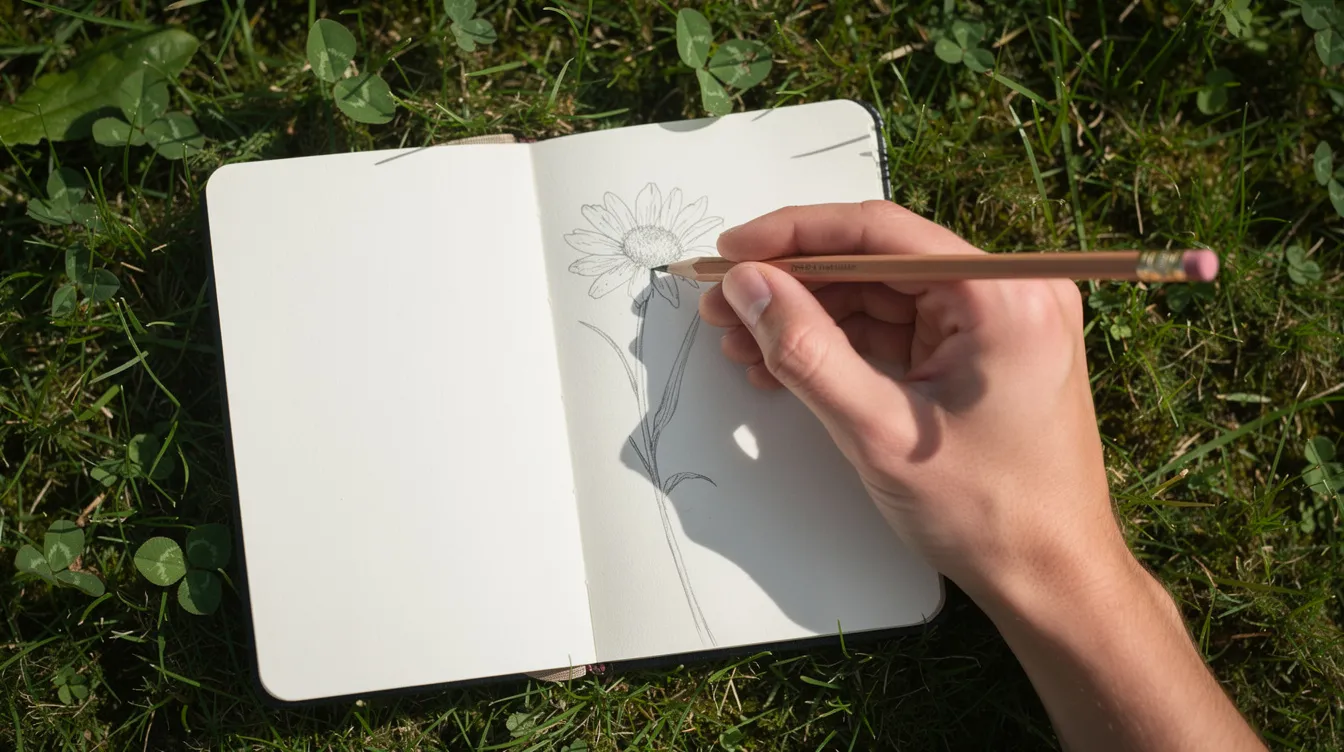
I pick one plant, not a whole meadow, then block in the stem line and a rough oval for the flower head. If the stem angle is off, no petal detail will rescue it. Quick gesture drawing can be done in just 5 seconds to find the overall posture before committing, then try again, giving yourself ten seconds on the second pass.
Then I add leaves where they attach, count petals as I go, and check the side view. I often include one close-up detail in a corner, usually where petals overlap or where a vein forks, because that is where I discover the most. The whole pencil sketch takes ten to twenty minutes, and stopping after the stem, head, and leaves is fine.
Tips for getting the shape right: compare, do not copy. Hold the pencil at arm’s length to measure the flower head against the stem length. Keep early lines light. Darken only what I am sure of.
Making Petals, Leaves, and Veins Look Natural
I try to draw what I see, not what I expect. I know what a daisy “should” look like, but real petals overlap, droop, twist, and sometimes go missing. That is part of the beauty.
Follow a leaf’s central vein first, then the lighter veins near the edges. Let each petal differ slightly. Even the funny asymmetry of a wind-battered bloom is worth recording, because that is evidence of a real plant in a real place.
Adding Color Without Losing the Drawing
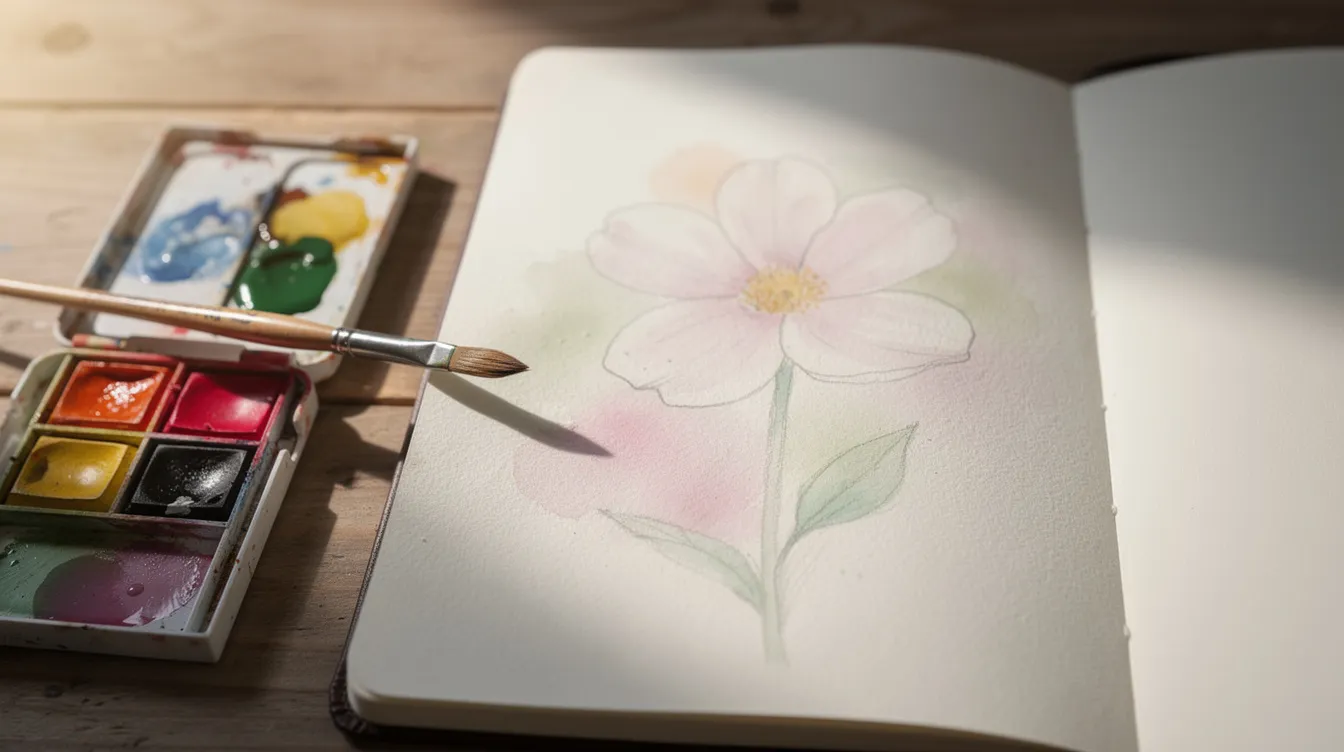
Watercolors can enhance your nature sketches without overwhelming them. I keep the color simple: a pale layer for petals, a mid green for leaves, and I stop before it gets fussy. I test the wash strength on a scrap first, then deepen shadows last. If you want to add watercolor to journal pages, the same small palette works well.
A small wash helps me remember the flower in the light I found it. That is all color needs to do. If a pencil line smudges under a wet brush, using a harder pencil grade or letting the graphite sit before washing solves the problem. I sometimes use ink for annotation after the wash dries, so the words stay sharp.
Recording What I Notice Beside the Sketch
The writing turns a sketch into a record. I keep it short and factual: date, place, time of day, weather in a few words, where the plant grew, its height and width, and color notes such as “petals pale violet, darker veins.” I add one thing that surprised me, and the scent if noticeable. I write the name if I know it, or a question mark if I do not.
Nature journaling encourages sharing your drawings online. Some people share their pages online on Instagram, and that is a fine way to connect with others who love this kind of work. I am glad when someone leaves a comment, though I write the notes for myself first.
Identifying a Wildflower Through Drawing
I used to feel I could not draw a plant until I knew its name. Now I draw first and identify later.
The drawing helps because I have already noticed what a field guide asks about: leaf arrangement, petal count, symmetry, whether the stem is hairy or smooth. I compare the sketch with the guide afterward, matching features rather than trying to match the whole shape at once. It turns out that drawing is one of the best ways to learn a plant.
Pressing Wildflowers for a Journal
I choose a fallen specimen where possible, or a single leaf from a plant with many. I place it between absorbent paper, add weight, and leave it in a dry place for a week or more depending on thickness. Once dry, the pressed flower sits beside the sketch on the page.
Leaving local plants in place matters. I never pick from small or struggling patches, and in public or protected places I sketch only.
Drawing Outdoors When I Feel I Cannot Draw
Lower the bar. One flower, ten minutes, no pressure. Some of my best pages came from days I almost did not bother. If you are new to this, you might start nature journaling with wildflowers before worrying about any of the rest.
Unfinished drawings still hold value. A half-finished sketch of a real flower beats a perfect one I never started. I accept uneven lines and move on. Time spent in natural settings can boost physical and mental well-being, and spending time in green spaces activates the calming parasympathetic nervous system. Spending time outdoors can lead to reduced anxiety and improved mood. Research suggests at least 120 minutes per week in nature yields health benefits, and a few short sessions with a sketchbook across the week add up quickly.
On wet or windy days I do a quick pencil sketch and written notes on the spot, then finish at home where my hands are warm.
Drawing Ideas for Walks
A few ideas that keep things interesting:
-
Sketch one flower from several angles on a single page
-
Do a single leaf study, filling a whole page with one leaf and its veins
-
Return to the same hedge or path across the seasons and compare what appears
-
Compare flowers from different places, side by side
-
Try drawing a bird, a seed pod, or the bark of trees you pass on the same walk
Drawing prompts like these can enhance your drawing practice. Participating in environmental activities, even something as small as recording what blooms in your garden each week, fosters connection to nature.
Related Books for Nature Journaling
A regional field guide with clear photos and a color index is the most useful book I own. Beyond that, browsing botanical drawing books gives ideas and inspiration without pressure. Related books on plants, animals, and the natural world support identification and spark curiosity.
Use books as references, not templates. The point is not to copy an artist’s style but to find different techniques for recording what I see, whether pencil, watercolor, or simple annotation.
Closing: Staying Drawn Into Nature
The hardest part for me has never been skill. It is showing up.
High nature connectedness is associated with greater eudaimonic well-being, and regular nature exposure can improve sleep quality and circadian rhythms. I do not think about those things while drawing, but I notice them over time. A year of walks and sketches changes the way I live.
Flip back through old posts and pages sometime. A year of spring flowers laid out is the best encouragement I know. Each page is a small account of a day, a place, and a plant I might otherwise have forgotten. The poetry of this work is in the quiet repetition: walk, stop, look, draw.
On your next walk, find one flower. Look closely. Keep the page uncomplicated. That is enough to start.
FAQ
Do I need to be good at drawing to feel drawn into nature this way? No. The benefit comes from attempting to draw nature, not from producing art for anyone else. Even rough, light lines capture proportion and petal count. I am not an artist by training, and I find the looking matters more than the result.
What is the minimum I need to get started? A pencil and a small sketchbook. That is enough. Everything else, including watercolors, colored pencils, and a hand lens, can come later when it feels like fun rather than a block.
How long should I spend on one flower? Ten minutes gives me shape, petal count, and leaf arrangement. Twenty minutes if I want to add a close-up detail or notes. Quick gesture drawing can be done in 5 seconds and is a useful way to warm up. There is no minimum and no maximum.
What if I cannot identify the plant? Draw it anyway and write a question mark beside the sketch. The drawing itself records the details a field guide will ask about later: leaf shape, petal number, stem structure. I often find the name days afterward, flipping through a book at home.
Is it all right to sketch in bad weather? Yes. On cold or rainy days I do a fast pencil sketch and jot down words about color, height, and habitat. I finish the drawing inside. Some encounters with wild plants happen in poor light or drizzle, and a rough page from those days is still worth having.